Group 1: Language & LiteratureSL AvailableHL Available

IB English A: Language and Literature

Critical study of texts across literary and non-literary forms with focus on analysis.

IB English A: Language and Literature develops skills in textual analysis across literary works and other text types. Students explore how language shapes meaning, identity, and culture while developing sophisticated written and oral communication skills. The current course was first assessed in 2021.
SL & HL
Levels offered
90 min
One-to-one lessons
$95
Lowest rate per lesson
Max 6
IB group programs
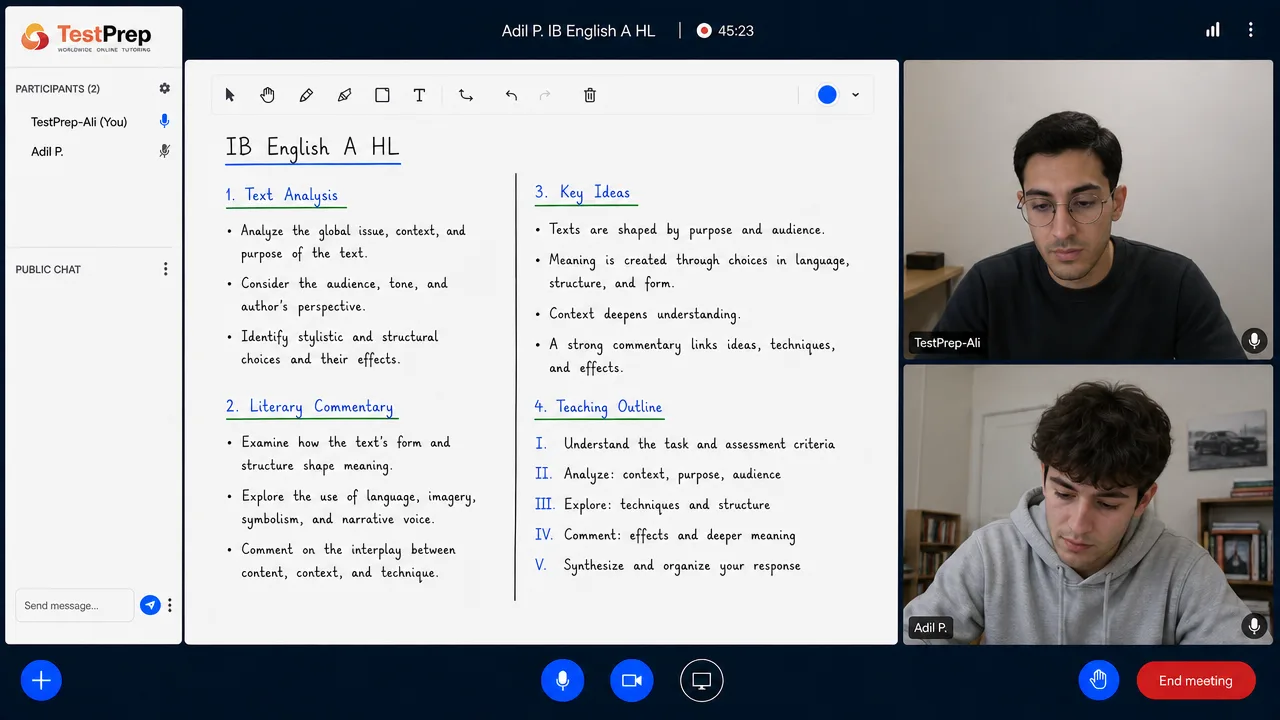
Whiteboard in an IB English A HL lesson: analysing a text's global issue, context and purpose, literary commentary on form and language, key ideas linking technique to effect, and a five-step teaching outline.
From a live online one-to-one IB English A HL lesson at the TestPrep Group
Course Introduction

Why English A Matters

Your grade in IB English A: Language and Literature counts toward the 45-point Diploma, and many university courses ask for a particular grade in the subject, often at Higher Level.
Essential for humanities and social science paths
Develops critical thinking and communication
Foundation for law, journalism, and media studies
Valuable for any career requiring written communication
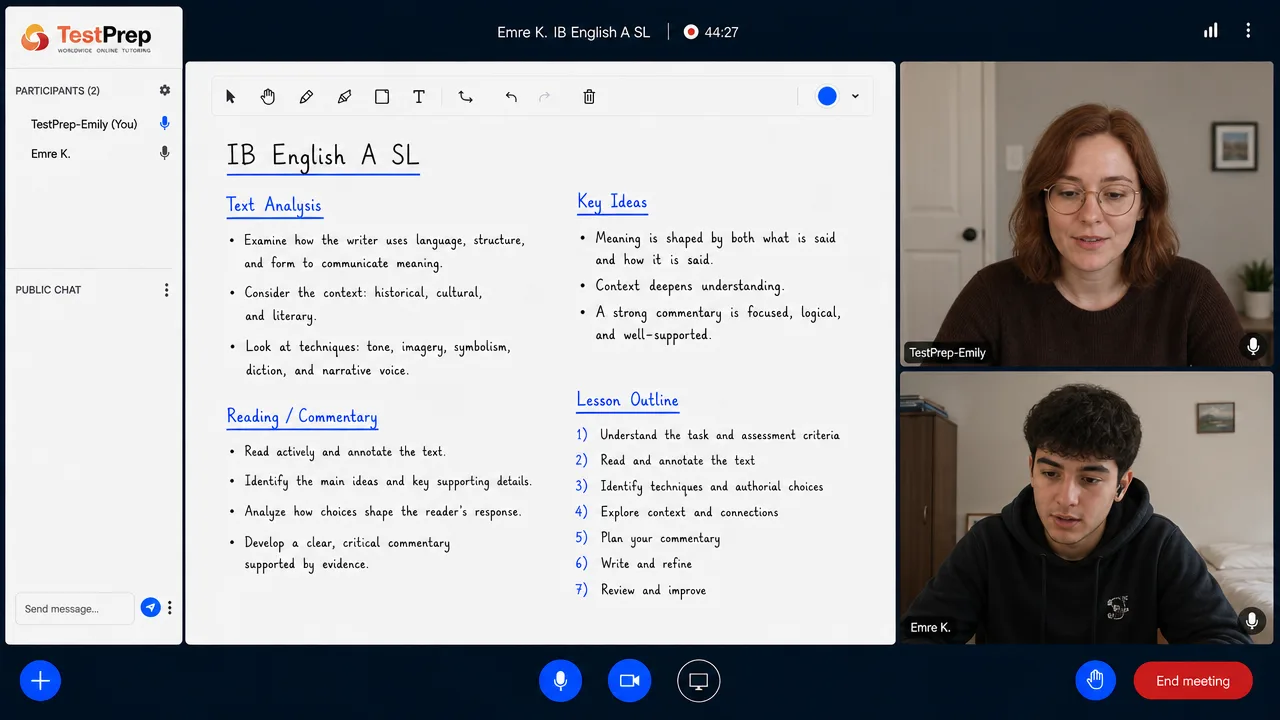
Whiteboard in an IB English A SL lesson: text analysis of language, structure and form, active-reading and commentary notes, key ideas on how meaning is shaped, and a seven-step lesson outline from annotating the text to revising the commentary.
Standard Level
SL Overview

SL covers text analysis, authorial choices, and intertextuality across at least 4 literary works and various non-literary texts in 150 hours.

Higher Level
HL Overview

HL requires at least six literary works, two guided analyses in Paper 1 and an HL essay, in 240 hours.

Career Pathways

LawJournalismPublishingEducationMarketingPublic RelationsDiplomacyWriting

English A syllabus topics

The topics of the subject guide. Lessons follow your school's order and level.

Unit 1
Readers, Writers, and Texts
  • Literary forms
  • Author's choices
  • Reader response
  • Context
Unit 2
Time and Space
  • Setting
  • Narrative perspective
  • Historical context
  • Cultural influences
Unit 3
Intertextuality: Connecting Texts
  • Connections between texts
  • Influence and allusion
  • Adaptation
  • Comparative analysis

How lessons approach English A

Understanding the concepts, and answering the papers the way the markscheme rewards.

Conceptual Understanding
Deep mastery of core concepts
  • Read actively with annotations
  • Practice close reading techniques
  • Connect texts to global issues
  • Develop vocabulary for literary analysis
Exam-Specific Techniques
Targeted preparation for IB assessments
  • Practice timed essay writing
  • Master the Paper 1 analytical structure
  • Prepare comparative frameworks for Paper 2
  • Practice IO structure and timing

Past papers and markschemes

IB English A past papers with examiner comments, used in lessons alongside the questions from your own school.

How marks are won in English A

1
Develop a strong thesis for every essay
2
Use specific textual evidence with analysis
3
Practice the Paper 1 structure extensively
4
Review assessment criteria for each component
5
Focus on sophisticated expression and vocabulary

IB English A: Language and Literature: lessons, prices and how to start

One-to-one lessons are 90 minutes, live online. Prices are set per program, so they are the same for every IB Diploma subject.

IB English A: Language and Literature one-to-one tutoring packages
Single lesson$100Per lesson: $100Buy a lesson
10 lessons$970Per lesson: $97Buy package
20 lessonsLowest rate$1,900Per lesson: $95Buy package

Group options

IB group teaching runs as three programs, priced by the number of subjects you take, in groups of at most 6:

IA, EE and TOK supervision is one-to-one, from $100 for a single lesson.

How do you start?

Request a free consultation: it is a conversation about your goals and timeline, not a lesson or a test. There is no separate diagnostic test for IB Diploma, because no single test stands in for a school syllabus. The first lesson does the assessment: your tutor works through your recent marked work and past-paper questions from your own specification, and reads where you stand. It is a normal paid lesson, not a free trial, and it teaches as it assesses.

Request a free consultation

Refunds

Not satisfied after your first private lesson? Full (100%) refund. No score is guaranteed. Full terms.

IB English A: Language and Literature — Frequently Asked Questions

What is the difference between IB English A: Language and Literature SL and HL?
Standard Level: SL covers text analysis, authorial choices, and intertextuality across at least 4 literary works and various non-literary texts in 150 hours. Higher Level: HL requires at least six literary works, two guided analyses in Paper 1 and an HL essay, in 240 hours. The choice matters for university admission as much as for workload — many courses require the subject at HL specifically.
How is IB English A: Language and Literature assessed?
Externally assessed: Paper 1 (SL: 35% / HL: 35%), Paper 2 (SL: 35% / HL: 25%), HL Essay (HL: 20%). Internally assessed: Individual Oral (SL: 30% / HL: 20%). The internal assessment is marked by your teacher and moderated by the IB, and because it is completed over months rather than in an exam hall it is the component students most often leave too late.
What topics does IB English A: Language and Literature cover?
The syllabus covers 3 topics: Readers, Writers, and Texts, Time and Space and Intertextuality: Connecting Texts. Lessons follow your school's order, so tutoring supports your class rather than running alongside it.
Does IB English A: Language and Literature count for university credit?
May grant credit for introductory literature or composition. Recognition varies by university and usually applies to Higher Level only, so check the policy of each institution you are applying to.
Where does IB English A: Language and Literature lead?
It is commonly taken by students heading towards Law, Journalism, Publishing, Education and 4 more. If your intended degree lists the subject as a requirement, taking it at Higher Level is usually what admissions expects.