Group 4: ScienceSL AvailableHL Available

IB Physics

Comprehensive physics covering mechanics, waves, electricity, and modern physics.

IB Physics enables students to develop a deep understanding of physical laws and theories through experimentation and mathematical analysis. The course covers fundamental physics principles and their applications, with HL extending into topics such as quantum physics and relativity. The current course was first assessed in 2025.
SL & HL
Levels offered
90 min
One-to-one lessons
$95
Lowest rate per lesson
Max 6
IB group programs
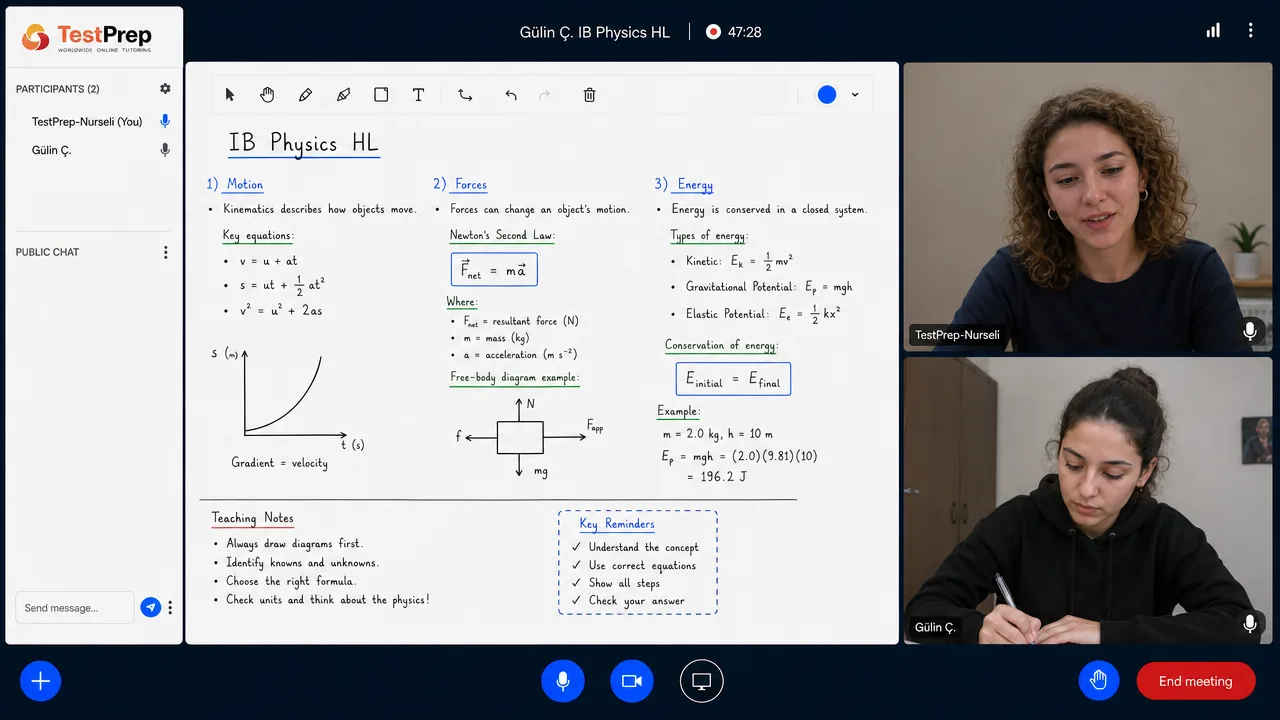
Whiteboard in an IB Physics HL lesson: the three kinematic equations with a displacement-time graph, Newton's second law with a free-body diagram, and conservation of energy worked through to a gravitational potential energy of 196.2 joules.
From a live online one-to-one IB Physics HL lesson at the TestPrep Group
Course Introduction

Why Physics Matters

Your grade in IB Physics counts toward the 45-point Diploma, and many university courses ask for a particular grade in the subject, often at Higher Level.
Essential for engineering and physical sciences
Develops quantitative problem-solving skills
Foundation for understanding natural phenomena
Relevant for engineering and physical science degrees
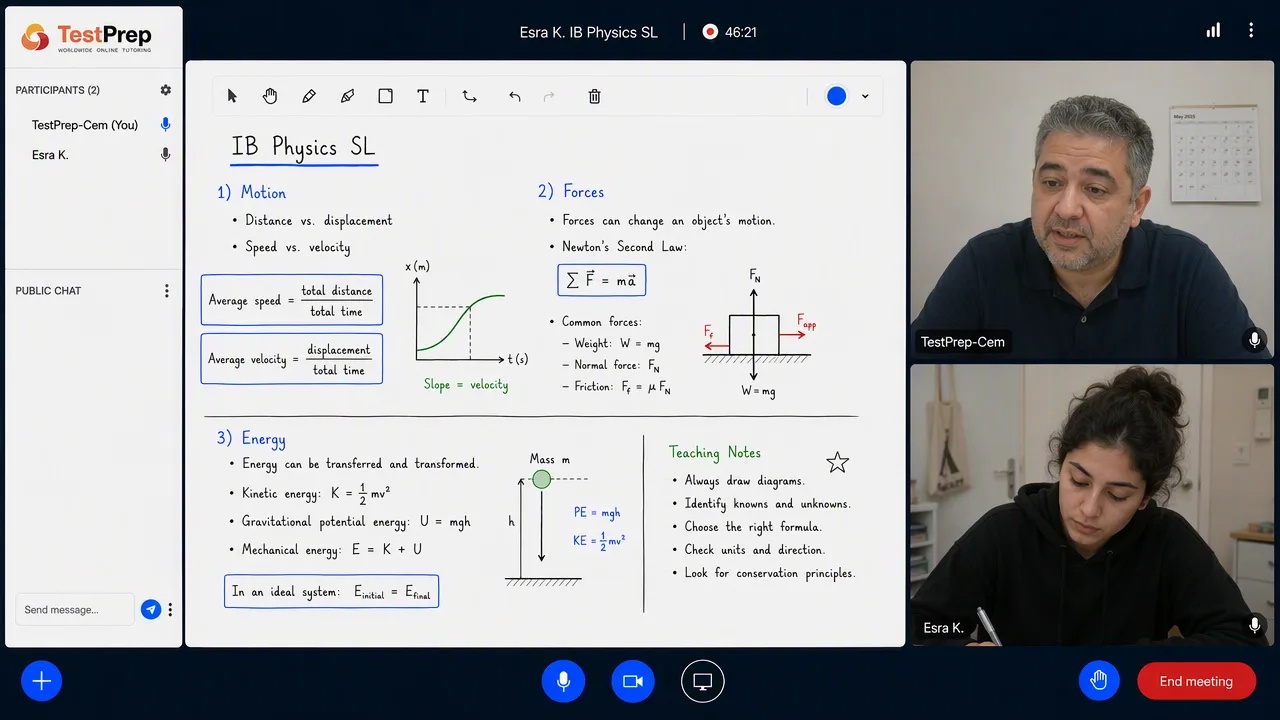
Whiteboard in an IB Physics SL lesson: distance against displacement with the average speed and velocity formulas and a displacement-time graph, forces with Newton's second law and a labelled free-body diagram, and energy with a falling-mass sketch.
Standard Level
SL Overview

SL covers core physics topics including mechanics, thermal physics, waves, electricity, and atomic physics in 150 hours.

Higher Level
HL Overview

HL adds rigid body mechanics, relativity, thermodynamics, induction and quantum physics, plus extra depth in other topics, in 240 hours.

Career Pathways

EngineeringPhysicsAstronomyMedicineArchitectureAviationResearchTechnology

Physics syllabus topics

The topics of the subject guide. Lessons follow your school's order and level.

Unit A
Space, Time, and Motion
  • Kinematics
  • Forces and momentum
  • Work, energy and power
  • Rigid body mechanics (HL)
  • Galilean and special relativity (HL)
Unit B
The Particulate Nature of Matter
  • Thermal energy transfers
  • Greenhouse effect
  • Gas laws
  • Thermodynamics (HL)
  • Current and circuits
Unit C
Wave Behaviour
  • Simple harmonic motion
  • Wave model
  • Wave phenomena
  • Standing waves and resonance
  • Doppler effect
Unit D
Fields
  • Gravitational fields
  • Electric and magnetic fields
  • Motion in electromagnetic fields
  • Induction (HL)
Unit E
Nuclear and Quantum Physics
  • Structure of the atom
  • Quantum physics (HL)
  • Radioactive decay
  • Fission
  • Fusion and stars

How lessons approach Physics

Understanding the concepts, and answering the papers the way the markscheme rewards.

Conceptual Understanding
Deep mastery of core concepts
  • Build strong mathematical foundations first
  • Visualize physical situations before calculating
  • Connect theory to real-world applications
  • Practice deriving equations from first principles
Exam-Specific Techniques
Targeted preparation for IB assessments
  • Memorize key formulas not on data booklet
  • Practice unit analysis for checking answers
  • Learn to extract information from graphs
  • Master the IA structure and criteria

Past papers and markschemes

IB Physics past papers with markschemes, used in lessons alongside the questions from your own school.

How marks are won in Physics

1
Show all steps in calculations for method marks
2
Draw clear, labeled diagrams
3
Use proper physics notation and units
4
Practice data booklet navigation
5
Review examiner reports for common mistakes

IB Physics: lessons, prices and how to start

One-to-one lessons are 90 minutes, live online. Prices are set per program, so they are the same for every IB Diploma subject.

IB Physics one-to-one tutoring packages
Single lesson$100Per lesson: $100Buy a lesson
10 lessons$970Per lesson: $97Buy package
20 lessonsLowest rate$1,900Per lesson: $95Buy package

Group options

IB group teaching runs as three programs, priced by the number of subjects you take, in groups of at most 6:

IA, EE and TOK supervision is one-to-one, from $100 for a single lesson.

How do you start?

Request a free consultation: it is a conversation about your goals and timeline, not a lesson or a test. There is no separate diagnostic test for IB Diploma, because no single test stands in for a school syllabus. The first lesson does the assessment: your tutor works through your recent marked work and past-paper questions from your own specification, and reads where you stand. It is a normal paid lesson, not a free trial, and it teaches as it assesses.

Request a free consultation

Refunds

Not satisfied after your first private lesson? Full (100%) refund. No score is guaranteed. Full terms.

IB Physics — Frequently Asked Questions

What is the difference between IB Physics SL and HL?
Standard Level: SL covers core physics topics including mechanics, thermal physics, waves, electricity, and atomic physics in 150 hours. Higher Level: HL adds rigid body mechanics, relativity, thermodynamics, induction and quantum physics, plus extra depth in other topics, in 240 hours. The choice matters for university admission as much as for workload — many courses require the subject at HL specifically.
How is IB Physics assessed?
Externally assessed: Paper 1 (SL: 36% / HL: 36%), Paper 2 (SL: 44% / HL: 44%). Internally assessed: Scientific Investigation (20%). The internal assessment is marked by your teacher and moderated by the IB, and because it is completed over months rather than in an exam hall it is the component students most often leave too late.
What topics does IB Physics cover?
The syllabus covers 5 topics: Space, Time, and Motion, The Particulate Nature of Matter, Wave Behaviour, Fields and Nuclear and Quantum Physics. Lessons follow your school's order, so tutoring supports your class rather than running alongside it.
Does IB Physics count for university credit?
Often grants credit for introductory physics courses. Recognition varies by university and usually applies to Higher Level only, so check the policy of each institution you are applying to.
Where does IB Physics lead?
It is commonly taken by students heading towards Engineering, Physics, Astronomy, Medicine and 4 more. If your intended degree lists the subject as a requirement, taking it at Higher Level is usually what admissions expects.